
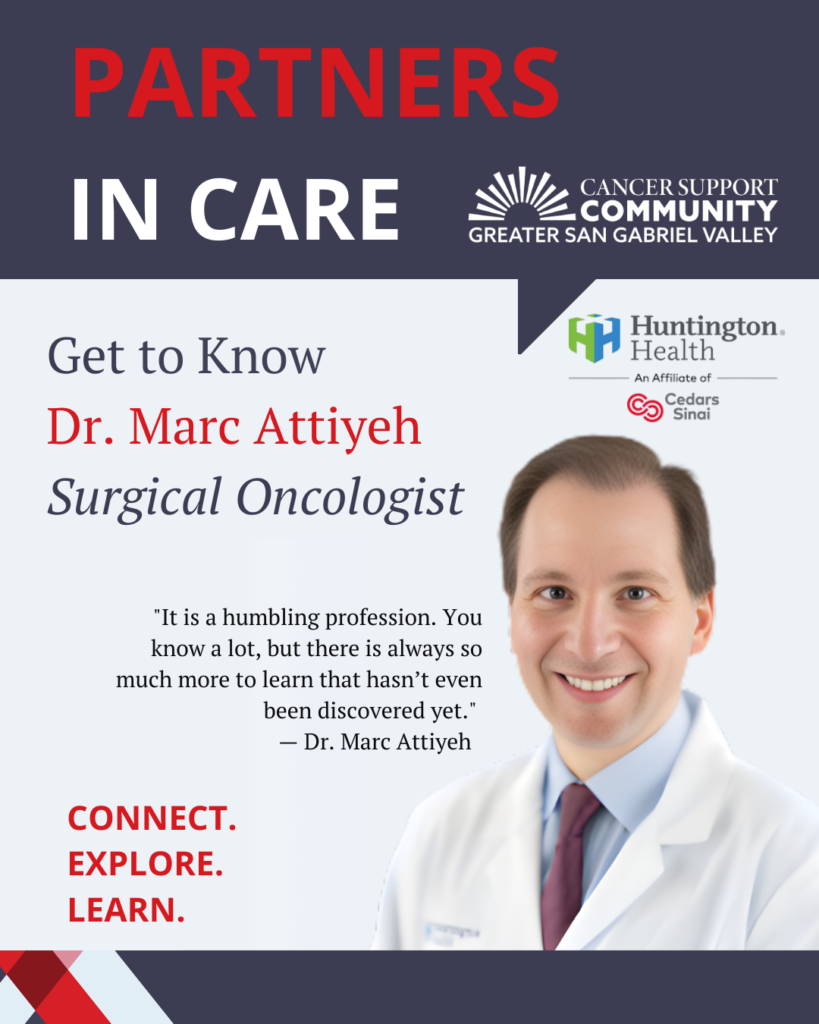
At Cancer Support Community Greater San Gabriel Valley, we believe that education empowers patients and families navigating cancer. Recently, we had the opportunity to speak with Dr. Marc Attiyeh, a surgical oncologist at Huntington Health, about melanoma, advances in treatment, and why early detection can make such a profound difference.
Surgical oncology is a specialized field focused on the surgical treatment of cancer, but Dr. Attiyeh’s role extends far beyond the operating room.
“Surgery isn’t always the answer,” he explains.
Surgical oncologists care for patients with many different types of cancer—including stomach cancer, colon cancer, liver cancer, sarcoma, melanoma, and others—and often work closely with medical oncologists, radiation oncologists, dermatologists, and plastic surgeons to determine the best treatment plan for each patient.
Why Melanoma Is So Important to Catch Early
Among the many cancers he treats, melanoma is a particular passion for Dr. Attiyeh. He is passionate about this because of the remarkable difference early detection can make.
“If melanoma is caught early, it is very curable,” he says.
For example, Stage 1 melanoma has a survival rate of approximately 97–98%. Similarly, cancers such as colon cancer and skin cancer can also have very high success rates when identified early.
When dermatologists biopsy a suspicious spot on the skin, the result may reveal several different types of skin cancer. The most common include:
- Basal Cell Carcinoma (BCC)
- Squamous Cell Carcinoma (SCC)
- Melanoma
The first two—BCC and SCC—are generally easier to treat and are often managed directly in the dermatologist’s office. Melanoma, however, is more complex and frequently requires surgical treatment and further evaluation.
Understanding the Pathology Report
One of Dr. Attiyeh’s priorities when meeting with patients is education.
He spends significant time reviewing pathology reports with patients to ensure they understand exactly what the findings mean.
“I really focus on explaining the pathology report in depth,” he says.
He often draws diagrams to help patients visualize the procedure and understand how melanoma grows within the layers of the skin.
A key detail in melanoma diagnosis is the depth of invasion, sometimes referred to as Breslow thickness. This measurement indicates how deeply the melanoma has grown into the skin, and even a difference of fractions of a millimeter can significantly affect staging and treatment decisions.
What Happens During Melanoma Surgery
When melanoma requires surgical removal, the procedure involves removing the tumor along with a margin of surrounding skin to ensure no cancer cells remain.
If a larger portion of skin must be removed, Dr. Attiyeh often collaborates with a plastic surgeon to help reconstruct the area and achieve the best possible functional and cosmetic outcome.
After removing the melanoma, surgeons frequently perform a procedure called a sentinel lymph node biopsy.
During this process, a special dye and a small amount of radioactive tracer are injected near the melanoma site. These substances travel through the lymphatic system, allowing surgeons to identify the first lymph node the cancer would likely spread to.
This lymph node—called the sentinel lymph node—is then removed and tested for cancer cells.
“If cancer were to spread to the lymph nodes, that would be the first place it would appear,” Dr. Attiyeh explains.
If melanoma is found in the lymph nodes, the disease may be classified as Stage 3 or Stage 4, and additional treatment—such as immunotherapy—may be recommended.
The Rise of Immunotherapy in Treating Melanoma
Over the past decade, one of the most significant advances in melanoma treatment has been the development of immunotherapy. Unlike traditional chemotherapy—which works by directly attacking rapidly dividing cells—immunotherapy helps activate the body’s own immune system to recognize and destroy cancer cells.
Melanoma has been one of the cancers where immunotherapy has had the most dramatic impact.
In particular, a class of drugs called immune checkpoint inhibitors has transformed treatment for patients with Stage 3 or metastatic (Stage 4) melanoma. These medications work by blocking proteins that normally act as “brakes” on the immune system. When those brakes are removed, immune cells—especially T-cells—can better detect and attack melanoma cells.
Common immunotherapy drugs used to treat melanoma target pathways such as PD-1, PD-L1, and CTLA-4, which are proteins that tumors can use to hide from the immune system.
For patients whose melanoma has spread to the lymph nodes or other organs, immunotherapy may be used:
- After surgery (adjuvant therapy) to reduce the risk of recurrence
- Before surgery (neoadjuvant therapy) to shrink tumors
- As the primary treatment when surgery is not possible or when the cancer has spread
Compared with traditional chemotherapy, immunotherapy is often better tolerated by patients, though it can still cause side effects because it stimulates the immune system. These effects can sometimes lead the immune system to attack normal organs, which is why patients receiving immunotherapy are carefully monitored by their care team.
For many patients with advanced melanoma, immunotherapy has significantly improved outcomes and long-term survival.
“These treatments have really changed the landscape of melanoma care,” Dr. Attiyeh explains.
Practical Advice for Monitoring Your Skin
Dr. Attiyeh encourages everyone to become familiar with the ABCDE rule when examining moles or spots on their skin.
Look for:
A – Asymmetry One half of the mole does not match the other.
B – Border Edges that are irregular, jagged, or blurred.
C – Color Multiple or uneven colors within the same spot.
D – Diameter Spots larger than about 6 millimeters (roughly the size of a pencil eraser).
E – Evolution Changes in size, shape, color, or symptoms over time.
“Evolution is often the most important,” Dr. Attiyeh says. “If a mole or spot is changing or growing, it should definitely be evaluated.”
He also reminds patients that melanoma does not only appear in sun-exposed areas. Although less common, it can occur on parts of the body that rarely see sunlight—and in rare cases, even internally within organs such as the gastrointestinal tract.
Using Genomics to Better Understand Cancer
Dr. Attiyeh’s background in computer science also led him to the field of genomics, an area of research that is transforming how scientists study cancer.
Genomics is the study of a person’s entire set of DNA—called the genome. DNA contains the genetic instructions that tell our cells how to grow, divide, and function. Cancer often develops when certain genes acquire mutations that cause cells to grow uncontrollably.
By studying the genetic makeup of tumors, researchers can better understand what is driving a particular cancer and how it might respond to treatment.
Modern genomic technologies allow scientists to analyze enormous amounts of genetic data from tumor samples. These techniques can identify specific mutations, gene alterations, or molecular signatures that may influence how a cancer behaves.
This information is becoming increasingly important for personalized medicine, an approach to treatment that tailors therapies to the unique biology of each patient’s tumor.
For example, genomic analysis may help doctors:
- Identify genetic mutations that caused the cancer to develop
- Predict how aggressive a tumor may be
- Determine which targeted therapies or immunotherapies may work best
- Understand why certain treatments succeed or fail
With the rapid growth of genomic data, researchers now face a different challenge: making sense of the information.
“There is an incredible amount of genetic data available today,” Dr. Attiyeh explains. “The question isn’t just how to obtain it—it’s how to analyze it.”
That’s where his computer science background plays an important role. By using programming and computational tools, he can analyze large genomic datasets and search for patterns that may reveal new insights into how cancers develop and spread.
In many ways, the computer has become his laboratory.
“In research,” he says, “you not only have to know what questions to ask—you also have to know how to go about answering them.”
A Humbling Profession
Despite the advances in cancer treatment and research, Dr. Attiyeh remains grounded by the complexity of the field.
“It is a humbling profession,” he reflects. “You know a lot, but there is always so much more to know that hasn’t even been discovered yet.”
That mindset continues to drive both his clinical work and his research as he strives to improve outcomes for patients facing cancer.
Join Dr. Attiyeh for an Upcoming Lunch & Learn
Community members will have the opportunity to hear directly from Dr. Attiyeh during an upcoming Lunch & Learn educational workshop hosted by Cancer Support Community Greater San Gabriel Valley.
📅 Tuesday, June 9
🕛 12:00 PM – 1:30 PM
📍 In-Person | CSC Greater San Gabriel Valley Community Room
331 W. Sierra Madre Blvd., Sierra Madre
During this session, Dr. Attiyeh will discuss melanoma, early detection, and advances in treatment, as well as provide practical guidance on sunscreen and protecting your skin. Attendees will also have the opportunity to ask questions and learn how to better monitor their skin using tools like the ABCDE rule for identifying concerning moles.
This educational program is open to the public, but registration is required. Registration will open on Tuesday, May 12th at cancersupport.link/Attiyeh. Educational workshops at CSC are designed to help patients, caregivers, and community members stay informed about prevention, treatment, and supportive care.