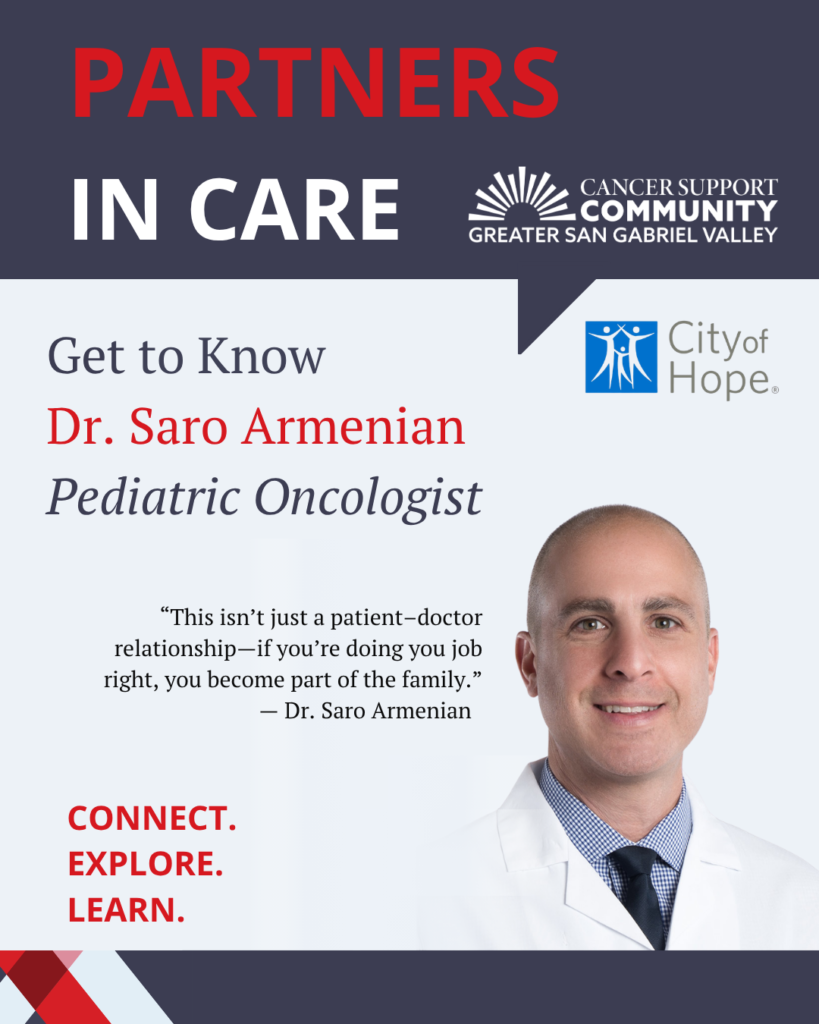
When you speak with Dr. Saro Armenian, you quickly understand that for him, cancer care is not defined solely by treatment—it is defined by what comes after. A pediatric oncologist by training and a leader in survivorship research, Dr. Armenian has devoted his career to understanding not just how we cure cancer, but how we help people live well beyond it.
“I love what I do,” he says simply. “It’s one of life’s greatest privileges.”
From Cure to Continuum
There was a time—particularly in the early 2000s—when the conversation around survivorship was largely centered on children. Pediatric oncology had reached a remarkable milestone: over 80% of children diagnosed with cancer were expected to be cured.
“That changed everything,” Dr. Armenian explains. “When cure becomes the expectation, the question shifts—from Can we save this life? to What will that life look like afterward?”
Because pediatric cancer is relatively rare, more than 200 cancer centers across the country came together in a coordinated effort—sharing data, resources, and research—to improve outcomes. This collaborative model became one of the most successful frameworks in modern medicine, accelerating discoveries and establishing new standards of care.
Today, that same lens is being applied to adult oncology. Increasingly, cure is becoming the expected outcome for many adult cancers as well—and with it comes a growing recognition that survivorship must be an integral part of care.
“The majority of survivors today are long-term survivors,” Dr. Armenian says. “Five years and beyond. That’s an incredible shift.”
The Science of What Comes Next
As survival rates improve, so too does our understanding of cancer’s long-term effects. Treatments that save lives can also leave lasting impacts on the heart, the endocrine system, cognition, and overall quality of life.
Dr. Armenian’s work sits at the intersection of science, prevention, and humanity—studying how to anticipate, monitor, and reduce these long-term effects so that survivorship is not just about living longer, but living better.
“We understand the biology of cancer more deeply than ever before,” he explains. “And we’re thinking differently now. Our therapies are more precise. Advances like immunotherapy have completely transformed what’s possible.”
But with innovation comes responsibility—to ensure that the very treatments that cure do not compromise the future.
More Than Medicine
For Dr. Armenian, the work is deeply personal—not in the sense of his own story, but in the relationships he builds along the way.
“This isn’t a 1:1 relationship,” he says. “If you’re doing your job right, you become like a family member.”
That philosophy reflects a broader ethos at City of Hope, captured in a guiding belief: there is no profit in curing the body if you destroy the soul.
It’s a sentiment Dr. Armenian carries with him, particularly when working with diverse patient populations. Cultural context, emotional well-being, family dynamics—all of these shape the cancer experience just as much as biology.
“To care for someone fully, you have to see all of them,” he says.
The Meaning of Survivorship
One of the most profound challenges in survivorship work is how to speak about it in the face of loss. Not every story ends in cure—and Dr. Armenian is acutely aware of the weight that reality carries.
“When we talk about survivorship with families who have lost someone, it’s not about minimizing that loss,” he says. “It’s about honoring it.” “When we talk about the cancer journey with families who have lost someone, it’s not about minimizing that loss,” he says. “It’s about honoring it.”
He speaks of progress not as a replacement for grief, but as a continuation of purpose.
“The fight continues. Their loved one’s journey contributes to the knowledge that helps us save more lives in the future. That matters.”
It is a perspective rooted in both science and reverence—an understanding that every patient, every trial, every outcome adds to a collective effort larger than any one individual.
The Power of Participation
Central to that effort is clinical research. Dr. Armenian emphasizes the importance of clinical trials—not as a last resort, but as a vital pathway to advancement.
“Everything we know today exists because someone was willing to participate,” he says. “Clinical trials are how we move forward.”
This spirit of collective contribution echoes the collaborative model that transformed pediatric oncology decades ago—and continues to shape the future of cancer care today.
Finding Peace in the Work
Despite the intensity of his field, Dr. Armenian speaks with a sense of calm clarity—someone who has found alignment between purpose and practice.
“I’ve found my peace and my piece,” he says.
It’s a quiet statement, but one that carries weight. For him, that peace comes from meaning—from knowing that his work matters, that it improves lives, and that it contributes to something enduring.
“I’m inspired by the people I surround myself with,” he adds. “The patients, the families, the teams. Doing this work—it’s one of life’s greatest privileges.”
A New Era of Hope
Cancer care today is, in many ways, revolutionary. The science is advancing rapidly, the outcomes are improving, and the definition of survival is expanding.
But if there is one thing Dr. Armenian makes clear, it is this: survival is not the finish line. It is the beginning of a new chapter—one that deserves just as much attention, care, and intention as the treatment itself.
And in that space—between cure and life—Dr. Armenian continues to lead, ensuring that hope is not just about survival, but about the quality, meaning, and fullness of the life that follows.
Join Dr. Saro Armenian at Cancer Support Community San Gabriel Valley on Tuesday, May 5 from 12:30–2:00 PM for a special Lunch & Learn on survivorship. In this insightful session, Dr. Armenian will explore what it truly means to live beyond cancer—sharing the latest advances in long-term care, the evolving science of survivorship, and how patients and families can navigate life after treatment with knowledge and confidence. Whether you are a survivor, caregiver, or simply looking to learn more, this is an opportunity to gain meaningful perspective from a leader in the field. Register today at cancersupport.link/Armenian.