
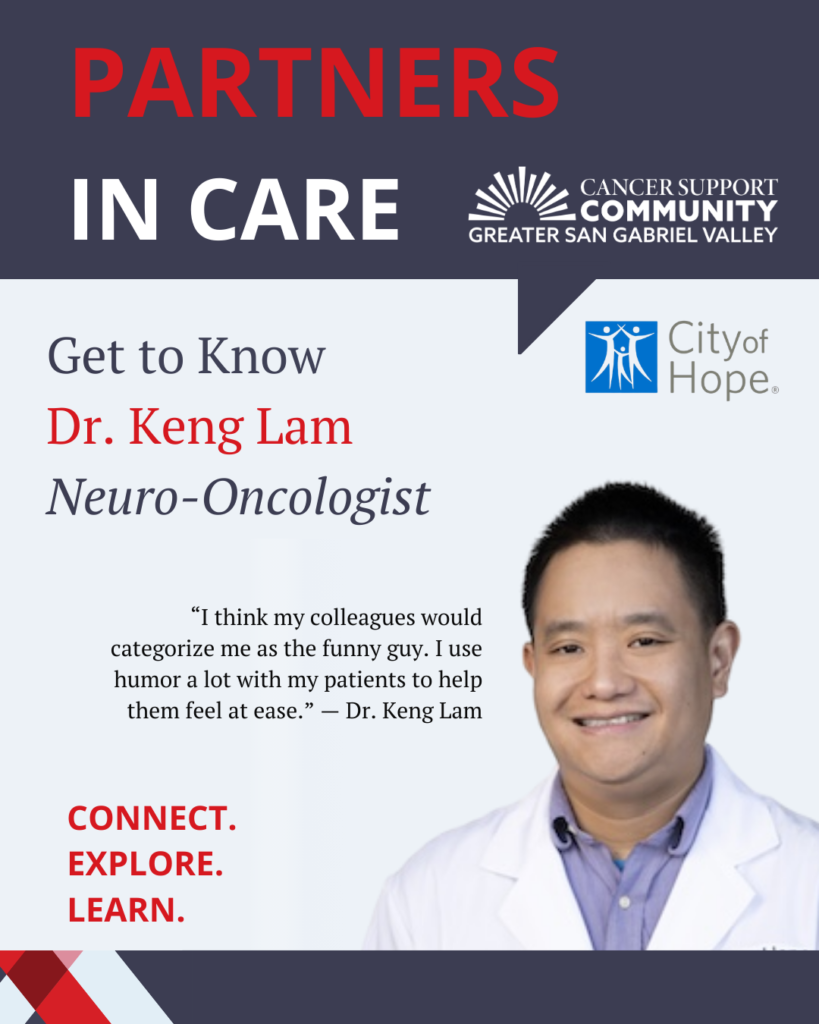
At Cancer Support Community Greater San Gabriel Valley, we believe that knowledge and connection are powerful forms of support. Recently, we had the opportunity to sit down with Dr. Keng Lam, a neuro-oncologist at City of Hope, to learn more about how cancer can affect the brain and what patients should know about symptoms, treatment, and care.
Dr. Lam’s path to neuro-oncology began during his neurology training, where he discovered a deep interest in caring for patients living with cancer. During his residency at Kaiser Permanente, he worked closely with cancer patients and realized how meaningful that work felt to him.
“I really enjoyed taking care of cancer patients,” he shared.
That experience led him to pursue a fellowship in neuro-oncology at MD Anderson Cancer Center, one of the nation’s leading cancer institutions. There, he specialized in treating cancers that affect the brain and nervous system.
When Cancer Spreads to the Brain
One of the most common questions patients ask is whether cancer can spread to the brain—and if so, which cancers are most likely to do so.
Dr. Lam explains that when cancer spreads from another part of the body to the brain, it is called brain metastasis, or metastatic brain cancer.
“Technically, cancer from almost anywhere in the body can travel to the brain,” he says.
However, some cancers are more likely to spread there than others.
“The most common cancers that metastasize to the brain are breast cancer and lung cancer,” Dr. Lam explains.
In some cases, cancer cells can also spread through the cerebrospinal fluid, the fluid that surrounds and protects the brain and spinal cord. This condition is known as leptomeningeal disease, and it can present unique treatment challenges.
Why Treating Brain Cancer Is Challenging
Treating cancers that affect the brain can be complicated because many medications struggle to reach brain tissue.
The brain is protected by a structure called the blood-brain barrier, which helps keep harmful substances out of the brain—but it can also block some cancer drugs from entering.
“The brain has this protective barrier,” Dr. Lam explains. “It can make it difficult for certain medications to reach tumors in the brain.”
However, researchers are making progress. Some drugs originally developed to treat cancers elsewhere in the body—particularly breast cancer—have been shown to cross the blood-brain barrier and can now be used to treat brain metastases in certain patients.
How Is Brain Involvement Discovered?
Cancer that spreads to the brain can sometimes be discovered during routine surveillance scans, which are imaging tests used to monitor cancer over time.
But other times, it is identified when patients begin experiencing new symptoms.
Dr. Lam encourages patients to pay close attention to changes in their health and report them to their care team.
Symptoms may include:
- New or persistent headaches
- Seizures
- Changes in vision or balance
- Difficulty with speech or memory
- Weakness or numbness
“If you suddenly develop symptoms that are unusual for you, it’s always worth mentioning to your doctor,” Dr. Lam advises. “For example, if you don’t normally get headaches and you suddenly start having them regularly, it’s better to check.”
Early communication with your medical team can help ensure concerns are evaluated quickly.
Treating the Whole Patient
Because Dr. Lam frequently treats cancers that have metastasized from other parts of the body, collaboration is essential.
At City of Hope, he works closely with oncologists, surgeons, radiation specialists, and other providers to create comprehensive treatment plans.
“It’s always a team approach,” he explains. “We work together to treat the whole patient.”
But medical collaboration is only part of the equation. Dr. Lam also takes time to understand the person behind the diagnosis.
He often asks patients about their personal lives, families, and priorities.
“It helps me remember them as individuals,” he says. “And it helps guide treatment decisions based on what matters most to them and their quality of life.”
Humor, Humanity, and Healing
For many patients, medical appointments can feel overwhelming. Dr. Lam understands that—and he often uses humor to help ease tension.
“I usually let patients set the tone,” he says. “If they crack a joke first, I’ll follow along.”
That lightness can help make difficult conversations feel a little more manageable.
A Global Perspective on Care
Dr. Lam’s background also shapes the way he connects with patients.
He is of Chinese heritage, grew up in the Dominican Republic, and later studied in the United States. As a result, he speaks English, Cantonese, and Spanish.
This multicultural background allows him to communicate with patients across languages and cultures—and to understand how different communities view illness and medical care.
When asked whether his background helps him in his work, he answers without hesitation.
“Absolutely,” he says.
Understanding cultural perspectives, family dynamics, and patient values can make a significant difference in building trust and delivering compassionate care.
Join Dr. Lam for an Educational Workshop
Dr. Lam will be sharing his expertise with the community during an upcoming virtual educational workshop hosted by Cancer Support Community Greater San Gabriel Valley.
Understanding Brain Cancer: Education & Support with Dr. Keng Lam
Join us for an informative session with Dr. Lam, a neuro-oncologist specializing in the treatment of brain and nervous system tumors. In this workshop, he will provide an overview of brain cancer, including common diagnoses, treatment approaches, and current advances in care, while offering insight into what patients and families may expect throughout the journey.
📅 Thursday, May 14
🕐 1:00 PM (Virtual on Zoom)
This program is open to the public, but registration is required in order to receive the Zoom link.
Registration opens April 16.
Participants can sign up at:
https://cancersupport.link/Lam
Knowledge and Support Matter
Learning about brain metastases and neurological symptoms can feel overwhelming, but understanding the signs—and having a trusted medical team—can make a difference.
At Cancer Support Community Greater San Gabriel Valley, we are grateful for partners like Dr. Lam and the City of Hope team who work every day to support patients and families facing cancer.
Together, through medical expertise, compassion, and community support, we continue our mission of ensuring that no one faces cancer alone.