
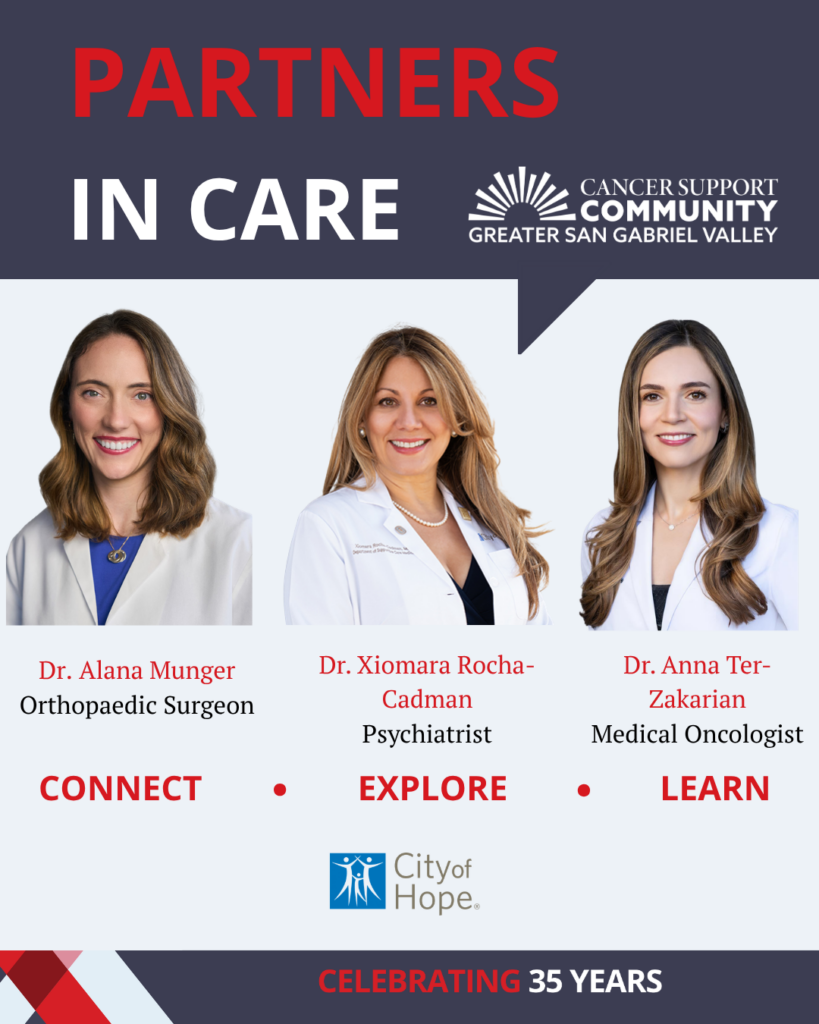
This quarter, Cancer Support Community Greater San Gabriel Valley has the privilege of welcoming three remarkable physicians whose expertise spans surgical oncology, psycho-oncology, and medical oncology. At first glance, their topics may seem distinct—sarcoma surgery, mental health during cancer, and navigating breast cancer—but together they tell a larger story about what comprehensive cancer care looks like today.
They also represent something equally significant: the growing influence of women leaders in medicine.
While women now make up roughly 37% of practicing hematologists and medical oncologists in the United States, they remain underrepresented in several cancer-related specialties—particularly orthopedic surgery, where women comprise fewer than 6% of practicing orthopedic surgeons. The landscape is changing thanks to physicians who are not only advancing science, but also redefining what compassionate, patient-centered care can be.
At CSC, we believe no one faces cancer alone. These three physicians embody that philosophy from different perspectives, reminding us that excellent cancer care extends far beyond treating a diagnosis.
Restoring Strength: Dr. Alana Munger
When patients hear the word sarcoma, they often find themselves navigating unfamiliar territory. As an orthopedic oncologic surgeon at City of Hope, Dr. Alana Munger specializes in the surgical treatment of bone and soft tissue sarcomas, as well as metastatic bone disease. Her work focuses not only on removing cancer, but on preserving mobility, independence, and quality of life.
Dr. Munger’s career reflects a commitment to excellence both inside and outside the operating room. A former NCAA national champion soccer player at UCLA, she graduated in the top 10% of her medical school class before completing advanced training at Yale and a musculoskeletal oncology fellowship at MD Anderson Cancer Center. She is also a passionate advocate for women in orthopedic surgery, creating the She Can Fix It podcast to encourage and elevate the next generation of female surgeons.
Her Lunch & Learn on sarcoma highlighted the importance of early diagnosis, multidisciplinary care, and surgical innovations that allow many patients to maintain function while receiving life-saving treatment.
Caring for the Whole Person: Dr. Xiomara Rocha-Cadman
Cancer affects far more than the body. Anxiety, depression, uncertainty, grief, and caregiver stress often become part of the cancer experience, yet emotional health has historically received far less attention than physical treatment.
That is exactly why Dr. Xiomara Rocha-Cadman, Chief of the Division of Psychiatry in the Department of Supportive Care Medicine at City of Hope, has dedicated her career to psycho-oncology—the specialized field that addresses the psychological and emotional aspects of cancer.
Inspired by her sister’s cancer diagnosis at age 26, Dr. Rocha-Cadman chose to focus on helping patients and families navigate the emotional challenges that accompany serious illness. She completed advanced fellowship training at Memorial Sloan Kettering Cancer Center and now leads initiatives supporting patients, caregivers, trainees, and health care professionals alike. She also champions culturally responsive care, including programs for Spanish-speaking patients and caregivers.
Her upcoming Lunch & Learn reminds us that mental health is not separate from cancer care—it is cancer care. Addressing emotional well-being improves quality of life, strengthens coping, and helps patients and families feel supported throughout every stage of treatment.
Guiding Patients Through Breast Cancer: Dr. Anna Ter-Zakarian
For individuals diagnosed with breast cancer, the journey can feel overwhelming. Understanding treatment options, navigating new medical terminology, and making difficult decisions often requires an experienced guide.
Dr. Anna Ter-Zakarian, a medical oncologist at City of Hope South Pasadena, is dedicated to helping patients navigate those decisions with expertise and compassion. Trained at the Keck School of Medicine at USC, with additional graduate degrees in global medicine and business administration, she combines scientific rigor with a patient-centered approach to care. After completing her hematology-oncology fellowship at Scripps Cancer Center, she joined City of Hope to contribute to its mission of advancing cutting-edge cancer treatment.
Her upcoming Lunch & Learn on navigating breast cancer will help patients better understand the treatment landscape while empowering them to become active partners in their own care.
Different Specialties, One Philosophy
Although these physicians practice in different disciplines, their work intersects in meaningful ways.
A patient diagnosed with sarcoma may first meet a surgeon like Dr. Munger. Throughout treatment, they may rely on emotional support from specialists like Dr. Rocha-Cadman. Patients facing breast cancer often work closely with medical oncologists like Dr. Ter-Zakarian while also benefiting from psychosocial care, rehabilitation, support groups, and survivorship resources.
Each physician represents one piece of a much larger picture: cancer care is most effective when it addresses the whole person—not just the disease.
Their collective work also reflects the evolution of oncology itself. Modern cancer treatment is increasingly collaborative, bringing together surgeons, medical oncologists, psychiatrists, rehabilitation specialists, nurses, social workers, and community organizations like CSC to support patients from diagnosis through survivorship.
As more women continue to shape the future of medicine, they are helping redefine leadership in oncology—not simply through groundbreaking research and clinical expertise, but through an unwavering commitment to compassionate, multidisciplinary care.
We are honored to welcome these outstanding physicians to Cancer Support Community Greater San Gabriel Valley and grateful for their partnership in ensuring that our community has access to trusted experts, evidence-based education, and the support needed so that no one faces cancer alone.